

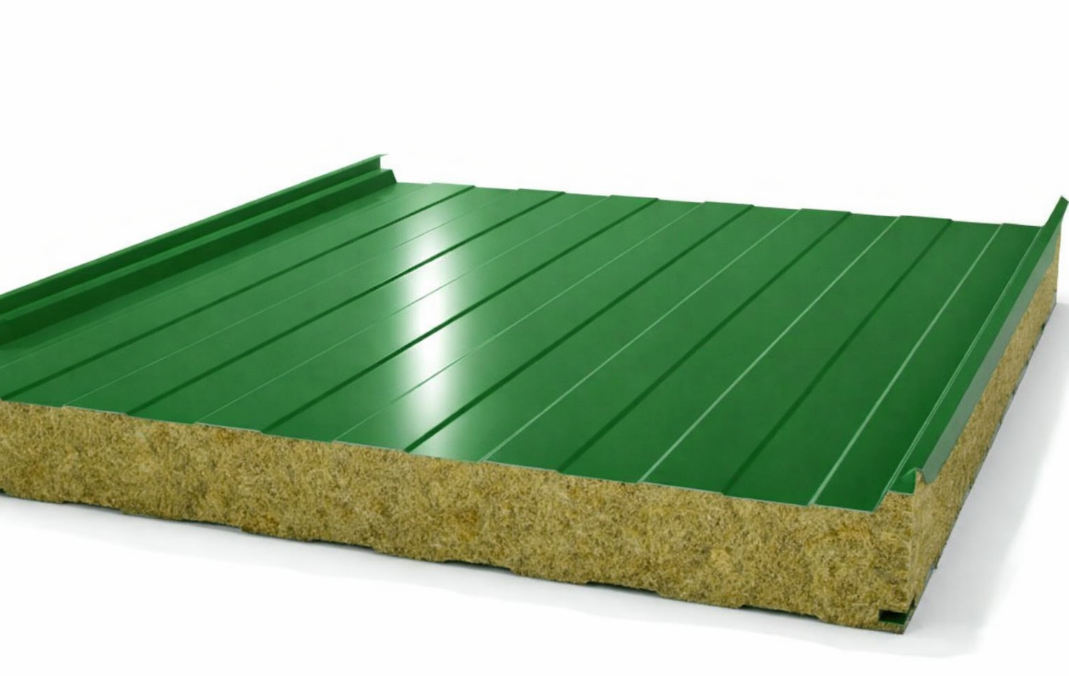
In modern industrial buildings, warehouses, production facilities, and large roofing applications, the most critical requirements are fire safety, sound insulation, and thermal control. One of the few materials that can provide all these benefits at the same time is rock wool (mineral wool).
Rock wool core materials used in sandwich panels significantly improve both safety and comfort of buildings.
What Is Rock Wool?
Rock wool is a mineral insulation material produced by melting basalt stone at around 1500°C and spinning it into fibers. Its fibrous structure provides excellent thermal and acoustic insulation while being completely non-combustible.
For this reason, rock wool is widely used in fire-resistant sandwich panel production.
What Is Rock Wool Used For?
🔥 Fire Resistance (A1 Non-Combustible)
Rock wool can withstand temperatures above 1000°C and prevents the spread of fire. Therefore, it is widely used in:
Factories
Warehouses
Logistics centers
Shopping malls and large buildings
Rock wool sandwich panels are often mandatory in such structures.
🔇 Superior Sound Insulation
Its fibrous structure absorbs noise and reduces echo, making it ideal for production facilities with high machine noise.
🌡️ Thermal Insulation and Energy Saving
Rock wool prevents heat loss in winter and heat gain in summer, reducing energy costs.
💧 Moisture Resistance
It is water-repellent, does not rot, and does not allow mold formation.
Where Are Rock Wool Sandwich Panels Used?
Industrial buildings subject to fire regulations
Production plants
Warehouses
Power plants
Noise-sensitive environments
When people refer to fire-rated sandwich panels, the core material is usually rock wool.