

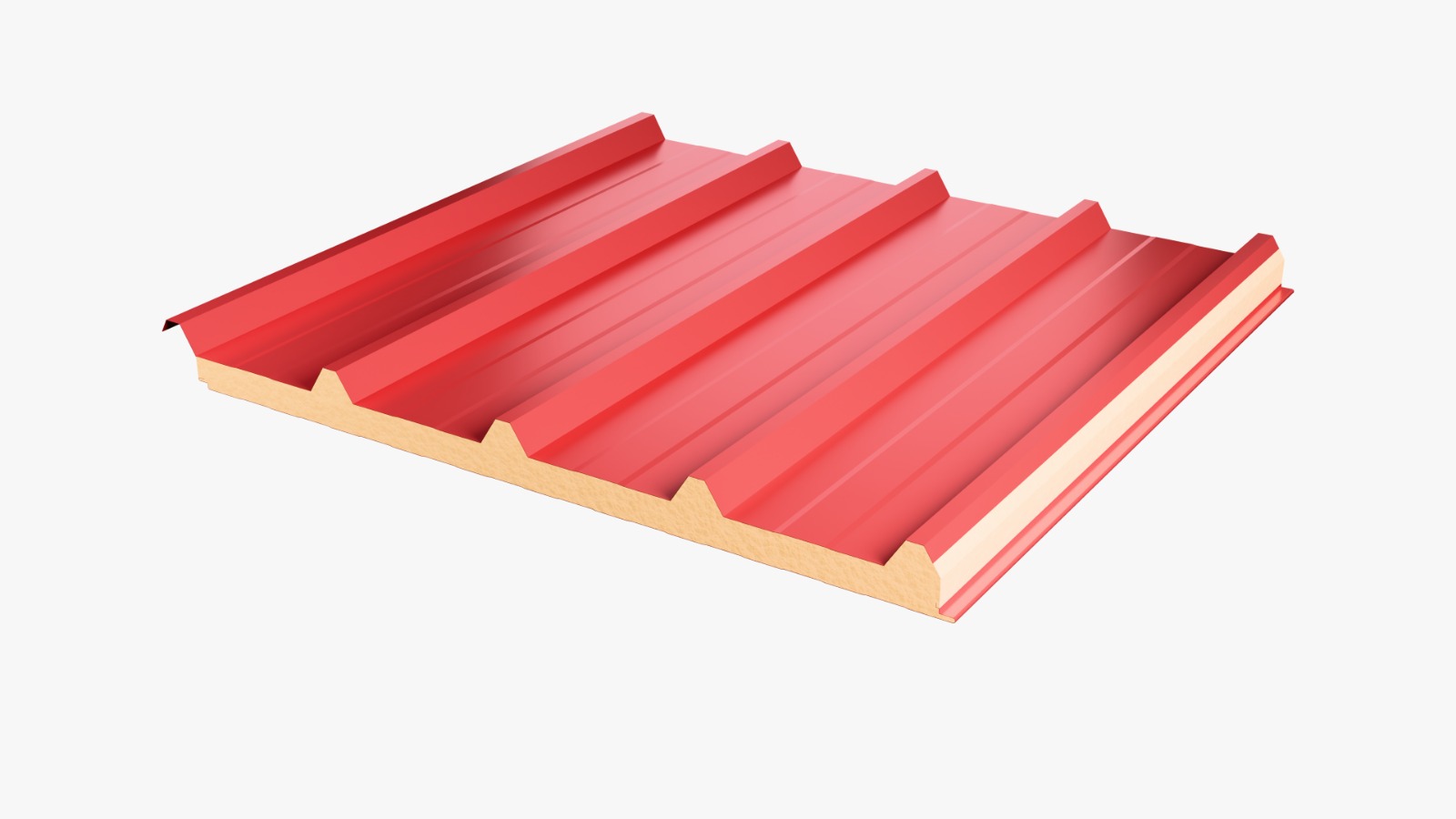
How Sandwich Panels Are Manufactured
Sandwich panels are high-performance building materials made by bonding two metal sheets with an insulated core material. These panels are widely used in industrial buildings, warehouses, cold rooms, and prefabricated structures due to their strength and thermal insulation.
The manufacturing process is fully automated and carried out in a continuous sandwich panel production line.
The process begins with steel coils placed on decoilers. The sheets are fed into roll forming stations where they are shaped into the desired panel profile. At the same time, the insulation core is prepared depending on the panel type.
For PU or PIR panels, liquid chemicals are injected between the sheets and expand to form a rigid foam. For rockwool or EPS panels, solid insulation boards are inserted automatically.
The layers move into a double belt press where heat and pressure ensure perfect bonding. After curing, the panels are cut to the required length and stacked for packaging.
Modern production lines ensure high precision, consistent quality, and high production capacity with minimal labor.
How Rockwool Sandwich Panels Are Produced
Rockwool sandwich panels are preferred for their fire resistance, acoustic insulation, and durability. Their production process differs from PU panels because the insulation core is a mineral wool slab instead of liquid chemicals.
The process starts with roll-formed metal sheets moving along the line. Pre-cut rockwool slabs are automatically placed between the sheets by a core feeding system.
A special adhesive system applies bonding material to ensure strong adhesion between the rockwool and metal surfaces.
The panel then enters a double belt press where pressure guarantees structural integrity. Unlike PU panels, temperature control is less critical, but pressure stability is essential.
After pressing, panels are cut to size and transferred to the stacking unit.
Precision in rockwool placement and adhesive application is the key to producing high-quality fire-resistant sandwich panels.
How PU Sandwich Panels Are Manufactured
PU sandwich panels are produced using polyurethane chemicals that expand and harden between two metal sheets, creating a lightweight yet highly insulated panel.
The process begins with coil feeding and roll forming of the metal sheets. Then, a high-pressure dosing machine injects mixed polyurethane chemicals onto the lower sheet.
As the upper sheet closes, the chemicals expand and fill the space uniformly. The panel moves into a heated double belt press where the foam cures under controlled temperature and pressure.
This stage is critical because improper temperature control can affect panel density and insulation quality.
After curing, the continuous panel is cut to desired lengths with a flying saw system.
PU panel production lines require precise chemical dosing, temperature control, and synchronization for optimal results.
Sandwich Panel Production Process Step by Step
The sandwich panel production process follows a continuous and synchronized sequence:
- Steel coil loading on decoilers
- Roll forming to shape panel surfaces
- Core material preparation (PU, PIR, Rockwool, EPS)
- Core application between sheets
- Pressing and bonding in double belt system
- Cooling and curing stage
- Automatic cutting to length
- Stacking and packaging
Each stage must work in harmony to maintain panel quality. Line speed, pressure, and alignment directly affect the final product.
Modern lines operate with automation systems that minimize human error and increase production efficiency.
Machines Required to Produce Sandwich Panels
A complete sandwich panel production line includes several synchronized machines:
- Decoilers for metal coils
- Roll forming machines for shaping sheets
- Core feeding or chemical dosing system
- Double belt press for bonding
- Flying saw for cutting panels
- Stacker and packaging system
- Automation and control units
The quality of each machine directly impacts the panel’s strength, insulation performance, and appearance.
Investing in reliable machinery ensures long-term production stability and lower maintenance costs.
Cost of Setting Up a Sandwich Panel Factory
Setting up a sandwich panel factory requires careful planning and investment in the right production technology.
The main cost factors include:
- Sandwich panel production line machinery
- Factory space and infrastructure
- Raw materials (steel coils, insulation core)
- Energy consumption
- Labor and automation level
The biggest investment is the production line itself, as it determines capacity and product quality.
Factories with modern automated lines benefit from higher output, lower labor costs, and consistent product standards.
Understanding the production process helps investors choose the right equipment and estimate return on investment accurately.