

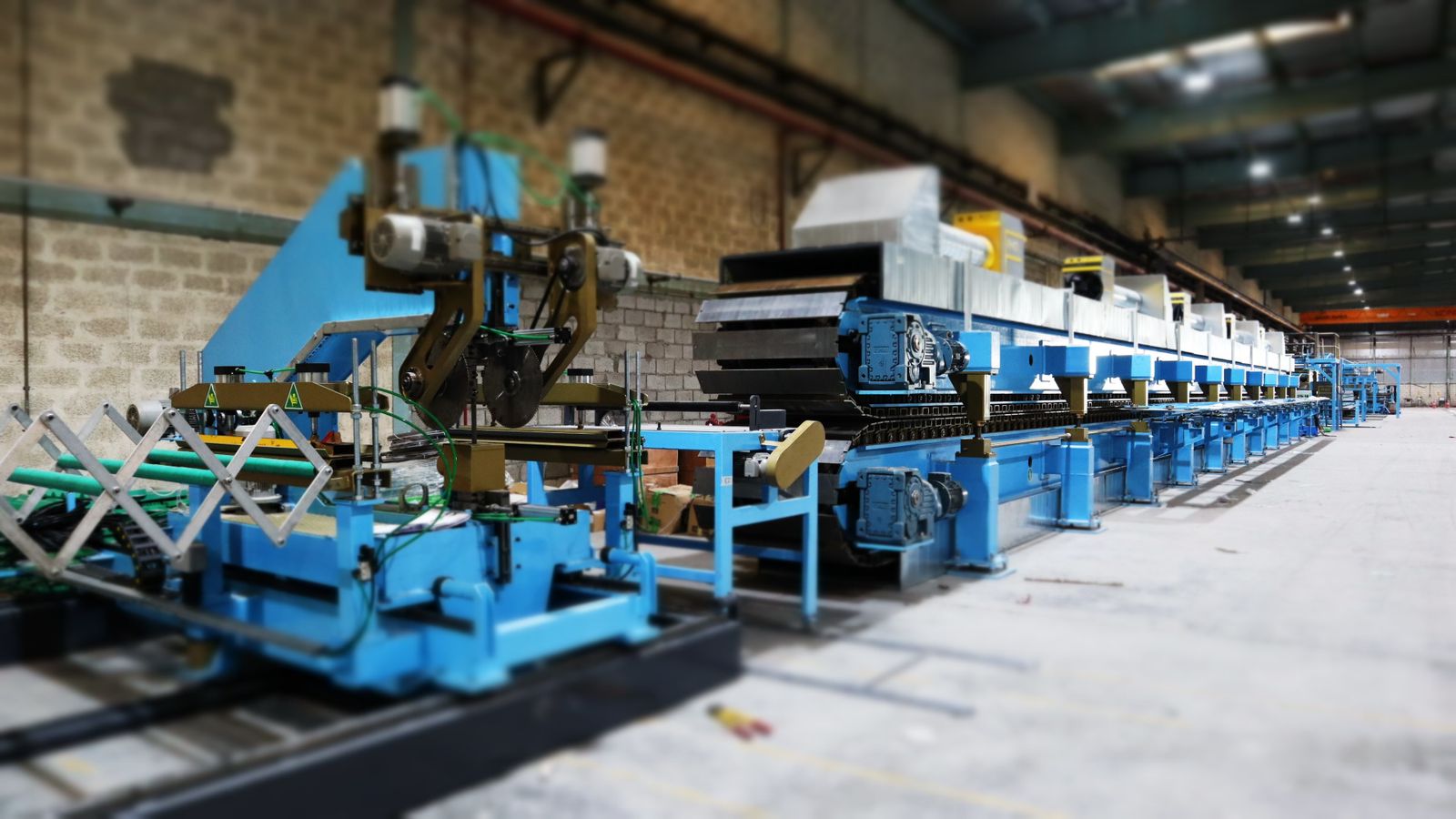
In sandwich panel production lines, product quality, dimensional accuracy, and surface consistency are highly dependent on the double belt press system and the performance of its side molds. Modern sandwich panel machines utilize advanced automation technologies to control these side molds with maximum precision.
This article explains how PLC-controlled, motor-driven XYZ movement systems improve production quality and efficiency.
The Role of Side Molds in Double Belt Systems
Side molds are responsible for:
Maintaining panel width
Preventing foam overflow
Defining panel edge geometry
Ensuring thickness consistency
Their precision directly affects the overall panel quality.
How High-Tech Side Mold Systems Work
In modern sandwich panel production lines, side molds:
Move in X, Y, and Z axes
Are driven by servo motors
Are controlled via PLC automation systems
Automatically adjust during production
This allows precise control of panel width and thickness without manual intervention.
Advantages of PLC-Controlled XYZ Movement Systems
1. High Dimensional Accuracy
Servo-controlled XYZ movements ensure minimal tolerances.
2. Fast Product Changeover
Recipe-based settings allow quick transitions between different panel sizes.
3. Reduced Operator Dependency
Automation minimizes human error during setup and production.
4. Stable and Repeatable Production
Consistent quality is achieved in every production cycle.
Contribution of Automation to Double Belt Performance
Advanced side mold automation results in:
Higher production speed
Lower scrap rates
Improved edge quality
Reduced maintenance costs
These benefits provide a strong competitive advantage for manufacturers.
Conclusion
PLC-controlled, motor-driven side mold systems in double belt sandwich panel machines represent the core of modern panel production technology. Their XYZ-axis automation capability ensures high quality, stable operation, and maximum efficiency.