

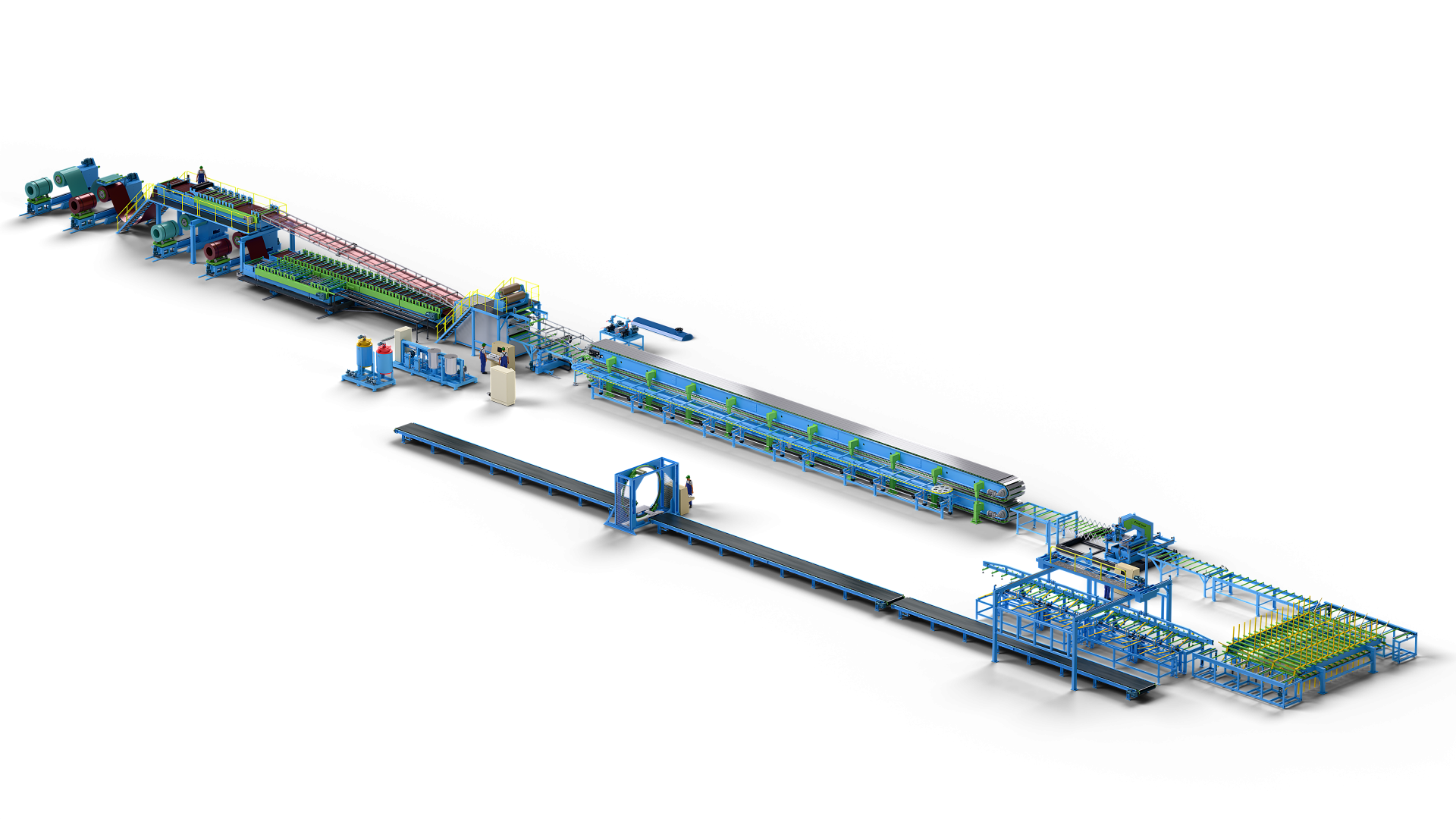
Production defects in sandwich panel production lines can lead to poor product quality, material waste, and customer complaints. Most of these issues can be prevented through proper machine configuration, regular maintenance, and precise process control.
This article outlines the most common production defects and effective prevention methods.
1. Panel Thickness Inconsistency
Issue
Uneven panel thickness causes installation problems and product rejection.
Causes
-
Unsynchronized line speed
-
Uneven press pressure
-
Incorrect chemical dosing
Prevention Methods
-
Synchronize all line speeds via automation
-
Regular calibration of press systems
-
Periodic inspection of dosing units
2. Surface Waviness and Sheet Deformation
Issue
Visible surface waves appear on the panel.
Causes
-
Poor sheet tension control
-
Incorrect decoiler settings
-
Misaligned roll forming stations
Prevention Methods
-
Use proper sheet tension control systems
-
Adjust the decoiler unit correctly
-
Precisely align roll forming machines
3. Weak Adhesion (Delamination)
Issue
Poor bonding between metal sheets and core material.
Causes
-
Incorrect chemical mixing ratios
-
Low surface temperature
-
Insufficient curing time
Prevention Methods
-
Control chemical ratios with automatic dosing
-
Maintain stable production temperatures
-
Adjust curing time according to line speed
4. Foam Overflow or Insufficient Filling
Issue
Voids or excessive foam inside the panel.
Causes
-
Incorrect injection volume
-
Mismatch between line speed and foam reaction time
Prevention Methods
-
Adjust injection volume based on panel thickness
-
Match line speed with foam reaction characteristics
5. Cutting and Length Accuracy Problems
Issue
Panels are cut to incorrect lengths.
Causes
-
Improper cutting unit calibration
-
Sensor malfunction
Prevention Methods
-
Regular maintenance of cutting systems
-
Periodic testing of measuring sensors